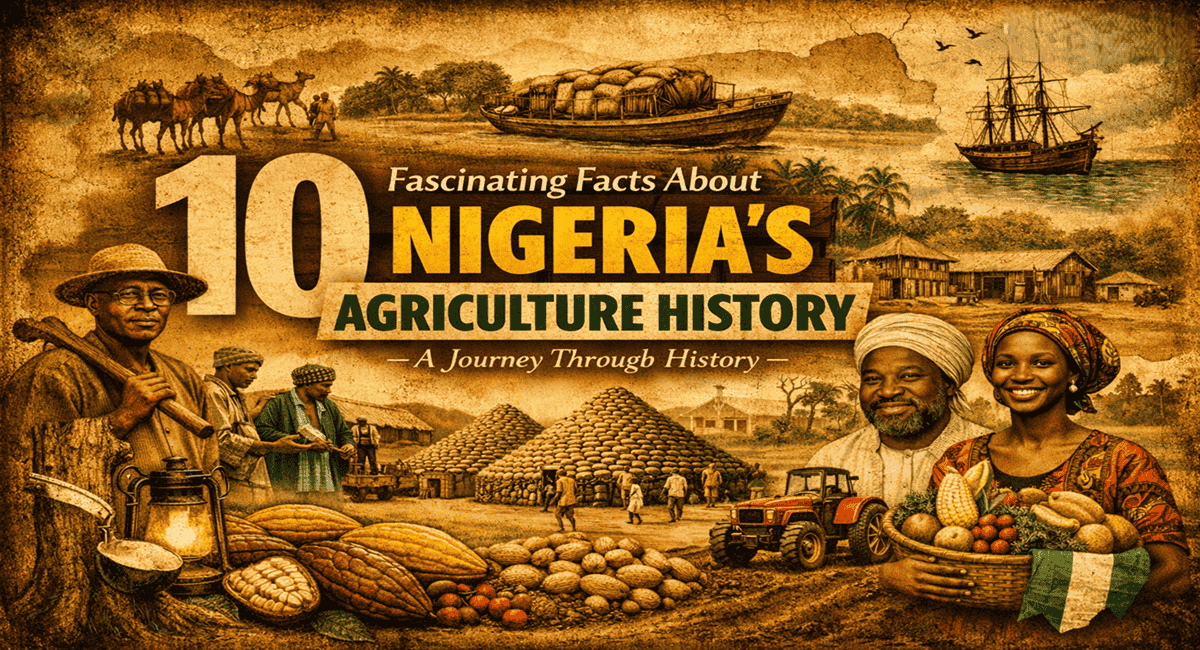
Nigeria’s agricultural journey spans over 3,000 years—from ancient yam cultivation in the Nok Culture to the iconic Groundnut Pyramids of Kano and today’s rise of agri-tech startups. This rich history reveals how traditional knowledge, colonial cash crops, and modern innovations have shaped the nation’s food systems and economic growth.
Here are 10 fascinating historical facts about Nigeria’s agriculture, showcasing its evolution from ancient farming practices to modern agribusiness:
1. Ancient Farming (Pre-Colonial Era – Before 1800s)
• Nigeria’s agriculture dates back over 3,000 years, with evidence of yam, millet, and sorghum cultivation in the Nok Culture (500 BC–200 AD).
• The Yoruba, Hausa, and Igbo developed advanced farming techniques, including crop rotation, terracing, and irrigation (e.g., the Zaria and Kano irrigation systems in Northern Nigeria).
• Palm oil production was a major trade commodity in the Bight of Biafra (now Niger Delta) as early as the 15th century, traded with European merchants.
2. The Trans-Saharan Trade (8th–16th Century)
• Northern Nigeria (especially Kano, Katsina, and Sokoto) was a hub for trans-Saharan trade, exporting groundnuts, cotton, and hides in exchange for salt, weapons, and textiles.
• The Hausa people were renowned for indigo dye production from plants, a key export to North Africa and Europe.
3. Colonial Agriculture (1800s–1960)
• The British introduced cash crop farming to fuel industrial Europe, leading to:
• Palm oil & kernel (Nigeria was the world’s largest exporter by the 1920s).
• Cocoa (introduced in 1874 by Tetteh Quarshie in Western Nigeria; by 1960, Nigeria was the 2nd-largest cocoa producer after Ghana).
• Groundnuts (peanuts) – The Kano Groundnut Pyramids (1960s) were a symbol of Nigeria’s agricultural wealth, with exports reaching 500,000 tons annually.
• Cotton – Used in British textile mills; Nigeria was a major supplier before synthetic fibers took over.
• Forced labor & exploitative policies disrupted traditional farming, leading to food shortages in some regions.
4. The Groundnut Pyramids of Kano (1960s)
• One of Nigeria’s most iconic agricultural landmarks, the Groundnut Pyramids were massive stacks of groundnut sacks (sometimes as tall as 14 meters) in Kano.
• At its peak, Nigeria supplied 40% of the world’s groundnuts, earning £60 million annually (equivalent to ~£1.5 billion today).
• The decline of the pyramids in the 1970s was due to:
• Oil boom neglect (agriculture was abandoned for petroleum).
• Droughts & pests (e.g., rosette disease).
• Global market shifts (competition from Asia & America).
5. Operation Feed the Nation (OFN) – 1976
Launched by General Olusegun Obasanjo, this was Nigeria’s first major agricultural revival program after the oil boom.
Goals:
• Reduce food imports (Nigeria was spending $1 billion annually on food imports).
• Encourage large-scale farming (e.g., river basin development for irrigation).
Results: Mixed success—some states (like Kaduna & Ogun) saw increased rice and maize production, but corruption and poor implementation limited impact.
6. The Green Revolution (1980s–1990s)
Inspired by global movements, Nigeria attempted its own Green Revolution under President Shehu Shagari (1980–1983).
Key initiatives:
• Subsidized fertilizers & improved seeds.
• Establishment of the Nigerian Agricultural Bank (NAB) to fund farmers.
Challenges:
• Smuggling of fertilizers to neighboring countries.
• Poor storage & transportation led to 30–40% post-harvest losses.
7. The Structural Adjustment Program (SAP) – 1986
• IMF/World Bank’s SAP forced Nigeria to devalue the naira and remove agricultural subsidies.
• Impact on farming:
• Fertilizer prices skyrocketed (from ₦50 to ₦500 per bag).
• Small farmers struggled, leading to declining food production.
• Rise of food imports (e.g., rice, wheat, and frozen chicken).
8. The Return of Agricultural Policies (2000s–Present)
2001: National Economic Empowerment and Development Strategy (NEEDS) – Focused on agribusiness and export-led growth.
2010: Agricultural Transformation Agenda (ATA) – Led by Dr. Akinwunmi Adesina (now AfDB President), this program:
• Distributed 4 million improved seeds to farmers.
• Introduced the e-wallet system to reduce fertilizer corruption (saved $1 billion in 4 years).
• Boosted rice production (Nigeria reduced rice imports by 40%).
2015: Anchor Borrowers’ Programme (ABP) – CBN’s loan scheme for smallholder farmers (especially rice, maize, and wheat).
2020: Green Imperative Project – A $1.2 billion mechanization deal with Brazil to supply 10,000 tractors and agro-equipment.
9. Nigeria’s Agricultural Export Ban (2019–Present)
• To boost local processing, Nigeria banned the export of raw agricultural commodities like:
• Cocoa beans (must be processed into chocolate or cocoa butter).
• Palm oil (must be refined before export).
• Hides & skins (must be processed into leather).
• Impact: Mixed—some local processors benefited, but smuggling increased due to weak enforcement.
10. The Rise of Agri-Tech & Modern Farming (2010s–Present)
Nigeria’s agri-tech sector is now one of Africa’s fastest-growing, with startups like:
• AgricPal (providing training and resources to young farmers).
• FarmCrowdy (crowdfunding for farmers).
• Thrive Agric (digital farming solutions).
• Hello Tractor (Uber-like tractor-sharing app).
• Vertical farming & hydroponics are emerging in Lagos and Abuja to combat urban food shortages.
• Government & private sector partnerships (e.g., Dangote’s $1 billion rice farm in five Nigerian states Edo, Jigawa, Kebbi, Kwara and Niger).
Bonus: Little-Known Facts
✅ Nigeria was once the world’s 4th-largest cocoa producer (1960s), but now ranks 6th due to aging trees and low productivity.
✅ The first rubber plantation in Nigeria was established in 1895 in Calabar by the British.
✅ Nigeria’s first agricultural research institute (now IITA – International Institute of Tropical Agriculture) was founded in 1967 in Ibadan.
✅ Before oil, agriculture contributed over 60% of Nigeria’s GDP (now ~23%).
Conclusion: Lessons from History
Nigeria’s agricultural journey shows:
✔ Colonial cash crops made Nigeria a global player but neglected food security.
✔ Oil dependency in the 1970s killed agricultural innovation.
✔ Recent reforms (e-wallet, ABP, agri-tech) are reviving the sector, but more investment is needed.
The future? If Nigeria combines traditional knowledge with modern tech, it could feed Africa and the world!
What’s the most surprising fact to you? Share in the comments! 🌱🇳🇬