Agriculture is the backbone of Nigeria’s economy, contributing 23.7% to the country’s GDP (as of 2023) and employing over 36% of the labor force. With a population exceeding 230 million and a growing demand for food, Nigeria’s agricultural sector holds immense potential for economic diversification, job creation, and food security.
However, despite its vast arable land (over 70 million hectares), favorable climate, and rich biodiversity, Nigeria still struggles with low productivity, post-harve
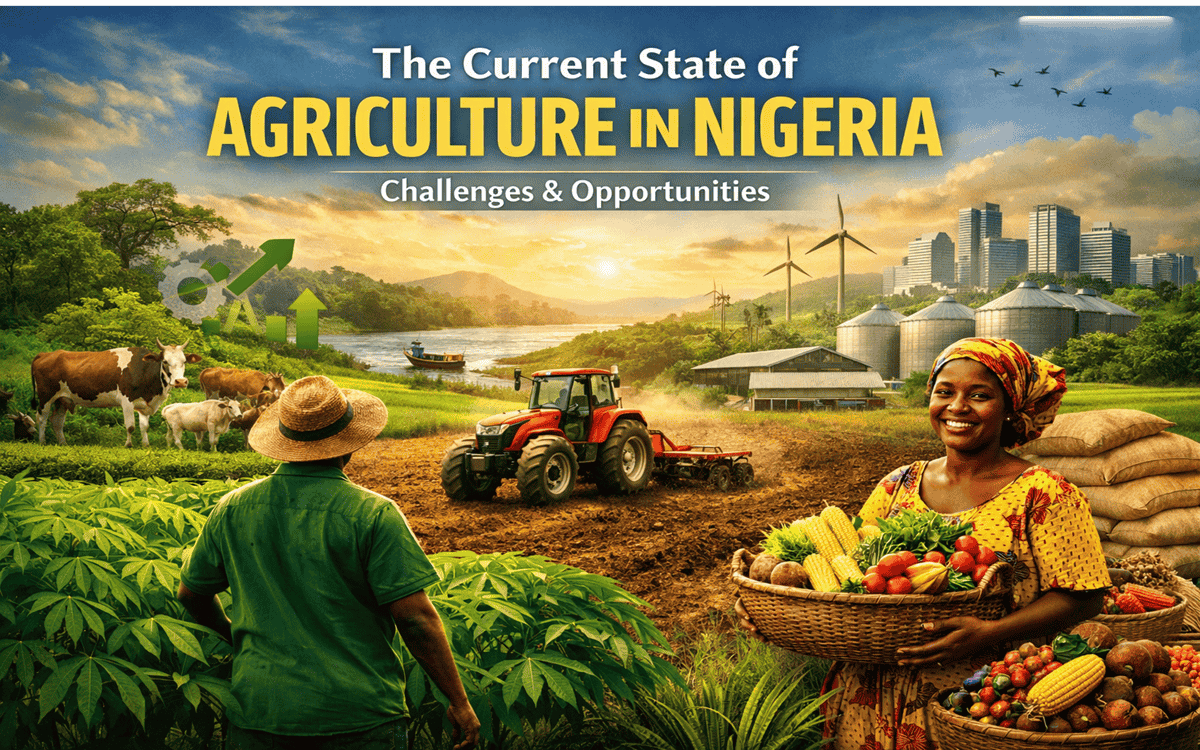
The Current State of Agriculture in Nigeria
1. Major Agricultural Sectors
Nigeria’s agriculture is diverse, with key sub-sectors including:
• Crop Production – Nigeria is a leading producer of cassava (world’s largest), yam, maize, rice, sorghum, millet, and cocoa.
• Livestock & Fisheries – The country has a large livestock population (cattle, goats, sheep, poultry) and a coastline of 853 km, supporting a thriving fisheries industry.
• Horticulture – Fruits like mangoes, pineapples, citrus, and vegetables (tomatoes, peppers, onions) are in high demand locally and internationally.
• Cash Crops – Cocoa, palm oil, rubber, and cotton remain significant export commodities.
2. Government Policies & Initiatives
The Nigerian government has introduced several policies to boost agriculture, including:
• Agricultural Promotion Policy (APP) 2016-2020 – Aimed at achieving self-sufficiency in key crops (rice, wheat, maize).
• Anchor Borrowers’ Programme (ABP) – A CBN initiative providing loans to smallholder farmers to improve production.
• National Livestock Transformation Plan (NLTP) – Addresses farmer-herder conflicts and promotes modern livestock farming.
• Green Imperative Project – A $1.2 billion mechanization program to enhance farm productivity.
• AfCFTA (African Continental Free Trade Area) – Opens new export markets for Nigerian agricultural products.
3. Contribution to GDP & Employment
• GDP Contribution: ~23.7% (2023)
• Employment: Over 36% of Nigerians work in agriculture (mostly smallholder farmers).
• Export Earnings: Agriculture accounts for ~5% of total exports, with cocoa, sesame seeds, and cashew nuts being major earners.
Key Challenges Facing Nigerian Agriculture
Despite its potential, Nigeria’s agricultural sector faces structural, economic, and environmental challenges:
1. Low Productivity & Outdated Farming Practices
• Smallholder dominance: Over 80% of farmers are small-scale, using manual tools and traditional methods.
• Low mechanization: Only 10,000 tractors are available for 70 million hectares of farmland (compared to India’s 900 tractors per 100,000 hectares).
• Poor access to improved seeds & fertilizers: Many farmers still use low-yielding varieties and inadequate inputs.
2. Inadequate Infrastructure & Post-Harvest Losses
• Poor storage & transportation: Up to 40% of crops (especially tomatoes, yam, and maize) are lost due to poor storage, bad roads, and lack of cold chains.
• Limited processing facilities: Most agricultural produce is sold raw, reducing value addition and export potential.
3. Climate Change & Environmental Degradation
• Droughts & desertification (especially in the North) reduce arable land.
• Flooding (e.g., 2022 floods destroyed over 1 million hectares of farmland).
• Deforestation & soil degradation from unsustainable farming practices.
4. Insecurity & Farmer-Herder Conflicts
• Banditry, kidnappings, and terrorism (especially in the North) disrupt farming activities.
• Farmer-herder clashes lead to crop destruction and loss of lives, reducing food production.
5. Limited Access to Finance & Markets
• High interest rates (often 20-30%) make loans unaffordable for small farmers.
• Poor market linkages lead to price fluctuations and exploitation by middlemen.
• Trade barriers (e.g., EU’s strict sanitary standards) limit export opportunities.
6. Policy Inconsistency & Corruption
• Frequent changes in agricultural policies create uncertainty.
• Mismanagement of funds (e.g., fertilizer subsidy scandals) undermines trust in government programs.
Opportunities for Growth in Nigerian Agriculture
Despite challenges, Nigeria’s agricultural sector presents huge investment and development opportunities:
1. Agribusiness & Value Addition
• Food processing (e.g., tomato paste, palm oil refining, cassava flour) can reduce imports and create jobs.
• Export-oriented farming (e.g., cashew, sesame, cocoa, ginger) can earn foreign exchange.
• Livestock & dairy processing (Nigeria imports $1.5 billion worth of dairy products annually—local production can replace this).
2. Technology & Digital Agriculture
• Precision farming (drones, IoT sensors) can optimize water and fertilizer use.
• Agri-fintech (e.g., FarmCrowdy, Thrive Agric) connects farmers with investors and markets.
• E-commerce platforms (e.g., Afrimash, AgroMall) help farmers sell produce directly to buyers.
3. Government & Private Sector Partnerships
• Public-Private Partnerships (PPPs) can improve infrastructure, storage, and processing.
• Foreign investments (e.g., Olam, Dangote, BUA) are expanding agro-industrial zones.
• Youth & women empowerment (e.g., NAYFF, WOFAN) can bring fresh ideas into farming.
4. Climate-Smart Agriculture (CSA)
• Drought-resistant crops (e.g., NERICA rice, improved maize varieties).
• Irrigation & water management (only 1% of farmland is irrigated).
• Agroforestry & sustainable land use to combat desertification.
5. Regional & International Trade
• AfCFTA opens a $3.4 trillion market for Nigerian agricultural exports.
• Economic diversification (reducing oil dependence) makes agriculture a key alternative revenue source.
Strategies for Sustainable Agricultural Growth
To unlock Nigeria’s agricultural potential, the following policy and practical steps are essential:
1. Mechanization & Modern Farming Techniques
• Subsidized tractors & farm equipment (like India’s Kisan Credit Card scheme).
• Training farmers on modern agronomic practices (e.g., FADAMA III Project).
2. Improved Infrastructure & Storage
• Cold storage facilities to reduce post-harvest losses.
• Rural road networks to connect farms to markets.
• Agro-industrial zones (e.g., Lagos Food Production Park, Ogun’s Agro-Cargo Airport).
3. Access to Finance & Insurance
• Low-interest loans for farmers (e.g., CBN’s ABP at 5% interest).
• Crop insurance schemes (e.g., NAIC’s Agricultural Insurance).
• Cooperatives & farmer groups to improve bargaining power.
4. Climate Resilience & Sustainable Practices
• Promoting climate-smart crops (e.g., drought-tolerant maize, flood-resistant rice).
• Renewable energy in farming (solar-powered irrigation, biogas from waste).
• Afforestation & soil conservation to combat desertification.
5. Security & Conflict Resolution
• Community-based conflict resolution between farmers and herders.
• Government intervention in banditry-prone areas to ensure safe farming.
6. Youth & Women Inclusion
• Agripreneurship programs (e.g., Tony Elumelu Foundation’s Agric Businesses).
• Digital literacy for farmers (mobile apps for weather forecasts, market prices).
• Land ownership reforms to encourage youth participation.
7. Export Promotion & Trade Facilitation
• Meeting international standards (e.g., EU’s Sanitary & Phytosanitary (SPS) requirements).
• Value addition before export (e.g., processed cocoa instead of raw beans).
• Leveraging AfCFTA to access new African markets.
Success Stories in Nigerian Agriculture
Despite challenges, some innovative farmers and agribusinesses are thriving:
1. Kogi State’s Rice Revolution – Kogi is now a major rice producer, supplying Oryza, Umza, and other brands.
2. Olam’s Integrated Farm in Nasarawa – A 10,000-hectare farm producing rice, maize, and soybeans with modern techniques.
3. Babban Gona (Kaduna) – A farmers’ cooperative that has increased maize yields by 200% using best practices.
4. Psaltry International (Ogun) – Nigeria’s largest cassava processor, exporting to Europe and Asia.
5. Thrive Agric – Agri-fintech platforms helping farmers access funds and markets.
Conclusion: The Future of Nigerian Agriculture
Nigeria’s agricultural sector is at a crossroads—it can either continue struggling with low productivity and food insecurity or transform into a global agribusiness hub. The key lies in:
✅ Modernizing farming (mechanization, technology, improved seeds).
✅ Investing in infrastructure (storage, roads, processing plants).
✅ Empowering farmers (finance, training, market access).
✅ Adopting climate-smart practices to ensure sustainability.
✅ Leveraging trade agreements (AfCFTA) for exports.
With strong government policies, private sector investments, and youth engagement, Nigeria can achieve food security, create millions of jobs, and become Africa’s leading agricultural powerhouse.
Call to Action
• Farmers: Adopt modern techniques, join cooperatives, and explore agribusiness.
• Government: Improve policies, infrastructure, and security for farmers.
• Investors: Explore opportunities in agro-processing, export, and agri-tech.
• Youth: Consider agripreneurship—the future of farming is tech-driven and profitable!
What are your thoughts on Nigeria’s agricultural potential? Share in the comments! 🌱🚜